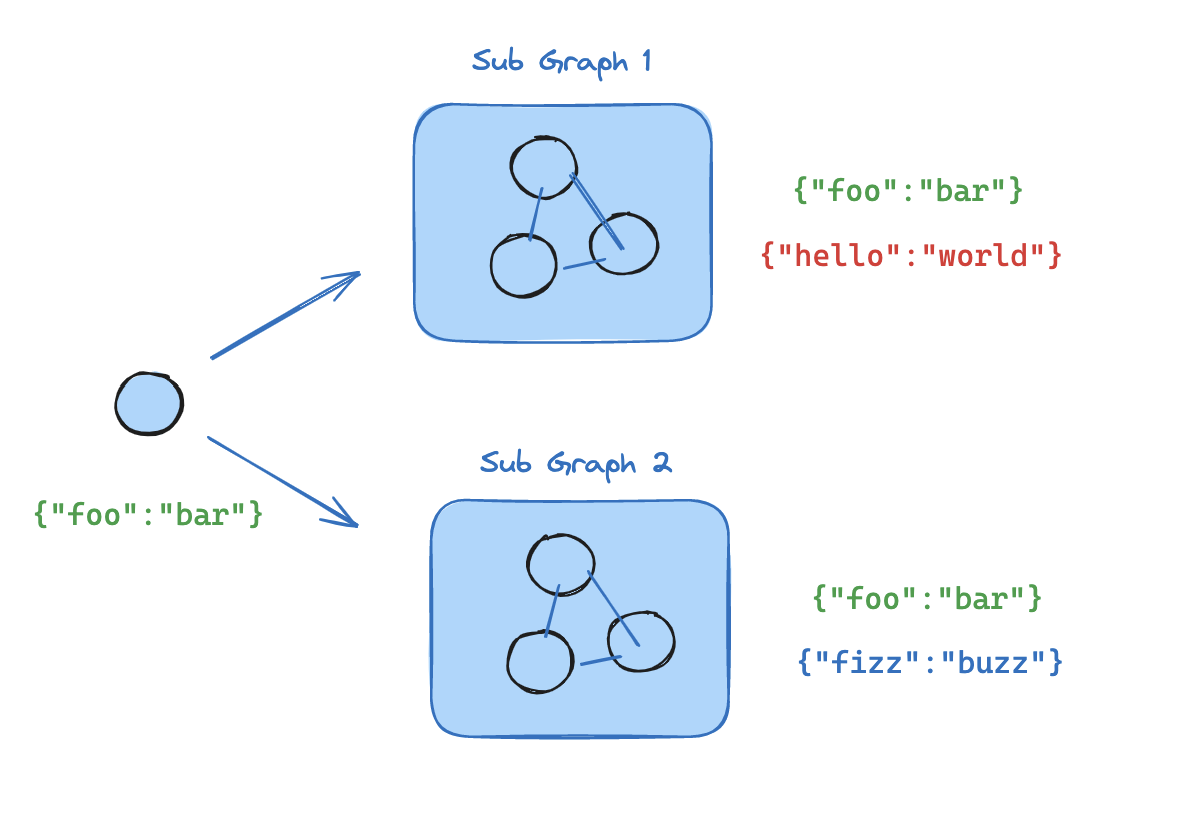
本指南说明如何使用子图的机制。子图是一个作为另一个图中的节点使用的 子图适用于:
  • 构建多智能体系统
  • 在多个图中复用一组节点
  • 分布式开发:当你希望不同团队独立开发图的不同部分时,可以将每个部分定义为子图。只要遵守子图接口(输入和输出 schema),父图就可以在不了解子图任何实现细节的情况下构建完成

Setup

npm install @langchain/langgraph
为 LangGraph 开发设置 LangSmith 注册 LangSmith,以便快速发现问题并提升 LangGraph 项目的性能。LangSmith 让你可以使用跟踪数据来调试、测试和监控使用 LangGraph 构建的 LLM 应用——阅读更多关于如何开始使用 LangSmith的信息。

Define subgraph communication

添加子图时,你需要定义父图和子图如何通信:
PatternWhen to useState schemas
在节点内部调用子图父图和子图具有不同的状态 schema(没有共享键),或者你需要在它们之间转换状态你需要编写一个包装函数,将父状态映射为子图输入,并将子图输出映射回父状态
将子图作为节点添加父图和子图共享状态键——子图从与父图相同的通道读取并写入你可以将已编译的子图直接传给 add_node——不需要包装函数

Call a subgraph inside a node

当父图和子图具有不同的状态 schema(没有共享键)时,可以在节点函数内部调用子图。当你希望在多智能体系统中为每个智能体保留私有消息历史时,这种方式很常见。 节点函数会先将父状态转换为子图状态,再调用子图;然后在返回前,将结果转换回父状态。
import { StateGraph, StateSchema, START } from "@langchain/langgraph";
import * as z from "zod";

const SubgraphState = new StateSchema({
  bar: z.string(),
});

// Subgraph
const subgraphBuilder = new StateGraph(SubgraphState)
  .addNode("subgraphNode1", (state) => {
    return { bar: "hi! " + state.bar };
  })
  .addEdge(START, "subgraphNode1");

const subgraph = subgraphBuilder.compile();

// Parent graph
const State = new StateSchema({
  foo: z.string(),
});

// Transform the state to the subgraph state and back
const builder = new StateGraph(State)
  .addNode("node1", async (state) => {
    const subgraphOutput = await subgraph.invoke({ bar: state.foo });
    return { foo: subgraphOutput.bar };
  })
  .addEdge(START, "node1");

const graph = builder.compile();
import { StateGraph, StateSchema, START } from "@langchain/langgraph";
import * as z from "zod";

// Define subgraph
const SubgraphState = new StateSchema({
  // note that none of these keys are shared with the parent graph state
  bar: z.string(),
  baz: z.string(),
});

const subgraphBuilder = new StateGraph(SubgraphState)
  .addNode("subgraphNode1", (state) => {
    return { baz: "baz" };
  })
  .addNode("subgraphNode2", (state) => {
    return { bar: state.bar + state.baz };
  })
  .addEdge(START, "subgraphNode1")
  .addEdge("subgraphNode1", "subgraphNode2");

const subgraph = subgraphBuilder.compile();

// Define parent graph
const ParentState = new StateSchema({
  foo: z.string(),
});

const builder = new StateGraph(ParentState)
  .addNode("node1", (state) => {
    return { foo: "hi! " + state.foo };
  })
  .addNode("node2", async (state) => {
    const response = await subgraph.invoke({ bar: state.foo });
    return { foo: response.bar };
  })
  .addEdge(START, "node1")
  .addEdge("node1", "node2");

const graph = builder.compile();

for await (const chunk of await graph.stream(
  { foo: "foo" },
  { subgraphs: true }
)) {
  console.log(chunk);
}
  1. 将状态转换为子图状态
  2. 将响应转换回父状态
[[], { node1: { foo: 'hi! foo' } }]
[['node2:9c36dd0f-151a-cb42-cbad-fa2f851f9ab7'], { subgraphNode1: { baz: 'baz' } }]
[['node2:9c36dd0f-151a-cb42-cbad-fa2f851f9ab7'], { subgraphNode2: { bar: 'hi! foobaz' } }]
[[], { node2: { foo: 'hi! foobaz' } }]
这是一个包含两层子图的示例:父级 -> 子级 -> 孙级。
import { StateGraph, StateSchema, START, END } from "@langchain/langgraph";
import * as z from "zod";

// Grandchild graph
const GrandChildState = new StateSchema({
  myGrandchildKey: z.string(),
});

const grandchild = new StateGraph(GrandChildState)
  .addNode("grandchild1", (state) => {
    // NOTE: child or parent keys will not be accessible here
    return { myGrandchildKey: state.myGrandchildKey + ", how are you" };
  })
  .addEdge(START, "grandchild1")
  .addEdge("grandchild1", END);

const grandchildGraph = grandchild.compile();

// Child graph
const ChildState = new StateSchema({
  myChildKey: z.string(),
});

const child = new StateGraph(ChildState)
  .addNode("child1", async (state) => {
    // NOTE: parent or grandchild keys won't be accessible here
    const grandchildGraphInput = { myGrandchildKey: state.myChildKey };
    const grandchildGraphOutput = await grandchildGraph.invoke(grandchildGraphInput);
    return { myChildKey: grandchildGraphOutput.myGrandchildKey + " today?" };
  })   
  .addEdge(START, "child1")
  .addEdge("child1", END);

const childGraph = child.compile();

// Parent graph
const ParentState = new StateSchema({
  myKey: z.string(),
});

const parent = new StateGraph(ParentState)
  .addNode("parent1", (state) => {
    // NOTE: child or grandchild keys won't be accessible here
    return { myKey: "hi " + state.myKey };
  })
  .addNode("child", async (state) => {
    const childGraphInput = { myChildKey: state.myKey };
    const childGraphOutput = await childGraph.invoke(childGraphInput);
    return { myKey: childGraphOutput.myChildKey };
  })   
  .addNode("parent2", (state) => {
    return { myKey: state.myKey + " bye!" };
  })
  .addEdge(START, "parent1")
  .addEdge("parent1", "child")
  .addEdge("child", "parent2")
  .addEdge("parent2", END);

const parentGraph = parent.compile();

for await (const chunk of await parentGraph.stream(
  { myKey: "Bob" },
  { subgraphs: true }
)) {
  console.log(chunk);
}
  1. 我们将状态从子级状态通道(myChildKey)转换为孙级状态通道(myGrandchildKey
  2. 我们将状态从孙级状态通道(myGrandchildKey)转换回子级状态通道(myChildKey
  3. 这里传入的是一个函数,而不仅仅是已编译的图(grandchildGraph
  4. 我们将状态从父级状态通道(myKey)转换为子级状态通道(myChildKey
  5. 我们将状态从子级状态通道(myChildKey)转换回父级状态通道(myKey
  6. 这里传入的是一个函数,而不仅仅是已编译的图(childGraph
[[], { parent1: { myKey: 'hi Bob' } }]
[['child:2e26e9ce-602f-862c-aa66-1ea5a4655e3b', 'child1:781bb3b1-3971-84ce-810b-acf819a03f9c'], { grandchild1: { myGrandchildKey: 'hi Bob, how are you' } }]
[['child:2e26e9ce-602f-862c-aa66-1ea5a4655e3b'], { child1: { myChildKey: 'hi Bob, how are you today?' } }]
[[], { child: { myKey: 'hi Bob, how are you today?' } }]
[[], { parent2: { myKey: 'hi Bob, how are you today? bye!' } }]

Add a subgraph as a node

当父图和子图共享状态键时,你可以将已编译的子图直接传给 add_node。不需要包装函数——子图会自动从父图的状态通道中读取并写入。例如,在多智能体系统中,智能体通常会通过共享的 messages 键进行通信。 SQL agent graph 如果你的子图与父图共享状态键,可以按照以下步骤将其添加到图中:
  1. 定义子图工作流(下面示例中的 subgraphBuilder)并编译它
  2. 在定义父图工作流时,将已编译的子图传给 .addNode 方法
import { StateGraph, StateSchema, START } from "@langchain/langgraph";
import * as z from "zod";

const State = new StateSchema({
  foo: z.string(),
});

// Subgraph
const subgraphBuilder = new StateGraph(State)
  .addNode("subgraphNode1", (state) => {
    return { foo: "hi! " + state.foo };
  })
  .addEdge(START, "subgraphNode1");

const subgraph = subgraphBuilder.compile();

// Parent graph
const builder = new StateGraph(State)
  .addNode("node1", subgraph)
  .addEdge(START, "node1");

const graph = builder.compile();
import { StateGraph, StateSchema, START } from "@langchain/langgraph";
import * as z from "zod";

// Define subgraph
const SubgraphState = new StateSchema({
  foo: z.string(),
  bar: z.string(),
});

const subgraphBuilder = new StateGraph(SubgraphState)
  .addNode("subgraphNode1", (state) => {
    return { bar: "bar" };
  })
  .addNode("subgraphNode2", (state) => {
    // note that this node is using a state key ('bar') that is only available in the subgraph
    // and is sending update on the shared state key ('foo')
    return { foo: state.foo + state.bar };
  })
  .addEdge(START, "subgraphNode1")
  .addEdge("subgraphNode1", "subgraphNode2");

const subgraph = subgraphBuilder.compile();

// Define parent graph
const ParentState = new StateSchema({
  foo: z.string(),
});

const builder = new StateGraph(ParentState)
  .addNode("node1", (state) => {
    return { foo: "hi! " + state.foo };
  })
  .addNode("node2", subgraph)
  .addEdge(START, "node1")
  .addEdge("node1", "node2");

const graph = builder.compile();

for await (const chunk of await graph.stream({ foo: "foo" })) {
  console.log(chunk);
}
  1. 这个键与父图状态共享
  2. 这个键是 SubgraphState 私有的,对父图不可见
{ node1: { foo: 'hi! foo' } }
{ node2: { foo: 'hi! foobar' } }

Subgraph persistence

使用子图时,你需要决定在两次调用之间如何处理它的内部数据。想象一个客服机器人会委派任务给专业子智能体:这个“账单专家”子智能体应该记住客户之前的问题,还是每次被调用时都重新开始? .compile() 上的 checkpointer 参数控制子图持久化:
Modecheckpointer=Behavior
按调用None(默认)每次调用都重新开始,并继承父图的 checkpointer,以支持单次调用内的中断持久执行
按线程True状态会在同一线程的多次调用之间累积。每次调用都会从上一次结束的位置继续。
无状态False完全不进行 checkpoint——像普通函数调用一样运行。不支持中断或持久执行。
对于大多数应用来说,按调用是正确选择,包括子智能体处理独立请求的多智能体系统。当子智能体需要多轮对话记忆时(例如,一个会在多次交流中逐步建立上下文的研究助手),请使用按线程模式。
父图必须使用 checkpointer 编译,子图持久化功能(中断、状态检查、按线程记忆)才能工作。参见持久化
下面的示例使用 LangChain 的 create_agent,这是构建智能体的常见方式。create_agent 底层会生成一个 LangGraph 图,因此所有子图持久化概念都可以直接应用。如果你使用原始的 LangGraph StateGraph 构建,同样的模式和配置选项也适用——详情参见 Graph API

Stateful

有状态子图会继承父图的 checkpointer,从而启用中断持久化和状态检查。这两种有状态模式的区别在于状态保留多久。

Per-invocation (default)

这是大多数应用推荐使用的模式,包括子智能体作为工具被调用的多智能体系统。它支持中断持久化和并行调用,同时保持每次调用相互隔离。
当每次对子图的调用都是独立的,并且子智能体不需要记住之前调用中的任何内容时,请使用按调用持久化。这是最常见的模式,尤其适用于多智能体系统:子智能体处理一次性请求,比如“查询这个客户的订单”或“总结这份文档”。 省略 checkpointer 或将其设置为 None。每次调用都会重新开始,但在单次调用内部,子图会继承父图的 checkpointer,并且可以使用 interrupt() 暂停和恢复。 下面的示例使用两个子智能体(水果专家、蔬菜专家),并将它们包装为外层智能体的工具:
import { createAgent, tool } from "langchain";
import { MemorySaver, Command, interrupt } from "@langchain/langgraph";
import * as z from "zod";

const fruitInfo = tool(
  (input) => `Info about ${input.fruitName}`,
  {
    name: "fruit_info",
    description: "Look up fruit info.",
    schema: z.object({ fruitName: z.string() }),
  }
);

const veggieInfo = tool(
  (input) => `Info about ${input.veggieName}`,
  {
    name: "veggie_info",
    description: "Look up veggie info.",
    schema: z.object({ veggieName: z.string() }),
  }
);

// Subagents - no checkpointer setting (inherits parent)
const fruitAgent = createAgent({
  model: "gpt-5.4-mini",
  tools: [fruitInfo],
  prompt: "You are a fruit expert. Use the fruit_info tool. Respond in one sentence.",
});

const veggieAgent = createAgent({
  model: "gpt-5.4-mini",
  tools: [veggieInfo],
  prompt: "You are a veggie expert. Use the veggie_info tool. Respond in one sentence.",
});

// Wrap subagents as tools for the outer agent
const askFruitExpert = tool(
  async (input) => {
    const response = await fruitAgent.invoke({
      messages: [{ role: "user", content: input.question }],
    });
    return response.messages[response.messages.length - 1].content;
  },
  {
    name: "ask_fruit_expert",
    description: "Ask the fruit expert. Use for ALL fruit questions.",
    schema: z.object({ question: z.string() }),
  }
);

const askVeggieExpert = tool(
  async (input) => {
    const response = await veggieAgent.invoke({
      messages: [{ role: "user", content: input.question }],
    });
    return response.messages[response.messages.length - 1].content;
  },
  {
    name: "ask_veggie_expert",
    description: "Ask the veggie expert. Use for ALL veggie questions.",
    schema: z.object({ question: z.string() }),
  }
);

// Outer agent with checkpointer
const agent = createAgent({
  model: "gpt-5.4-mini",
  tools: [askFruitExpert, askVeggieExpert],
  prompt:
    "You have two experts: ask_fruit_expert and ask_veggie_expert. " +
    "ALWAYS delegate questions to the appropriate expert.",
  checkpointer: new MemorySaver(),
});
每次调用都可以使用 interrupt() 暂停和恢复。在工具函数中添加 interrupt(),即可在继续执行前要求用户批准:
const fruitInfo = tool(
  (input) => {
    interrupt("continue?");
    return `Info about ${input.fruitName}`;
  },
  {
    name: "fruit_info",
    description: "Look up fruit info.",
    schema: z.object({ fruitName: z.string() }),
  }
);
const config = { configurable: { thread_id: "1" } };

// Invoke - the subagent's tool calls interrupt()
let response = await agent.invoke(
  { messages: [{ role: "user", content: "Tell me about apples" }] },
  config,
);
// response contains __interrupt__

// Resume - approve the interrupt
response = await agent.invoke(new Command({ resume: true }), config);
// Subagent message count: 4

Per-thread

当子智能体需要记住之前的交互时,请使用按线程持久化。例如,一个会在多次交流中逐步积累上下文的研究助手,或者一个会跟踪已经编辑过哪些文件的编码助手。子智能体的对话历史和数据会在同一线程的多次调用之间累积。每次调用都会从上一次结束的位置继续。 使用 checkpointer=True 编译即可启用这种行为。
按线程子图不支持并行工具调用。当 LLM 可以将按线程子智能体作为工具使用时,它可能会尝试并行多次调用该工具(例如,同时询问水果专家关于苹果和香蕉的问题)。这会导致 checkpoint 冲突,因为两次调用都会写入同一个命名空间。下面的示例使用 LangChain 的 ToolCallLimitMiddleware 来避免这种情况。如果你使用纯 LangGraph StateGraph 构建,则需要自行阻止并行工具调用——例如,通过配置模型禁用并行工具调用,或者添加逻辑确保同一个子图不会被并行调用多次。
下面的示例使用一个通过 checkpointer=True 编译的水果专家子智能体:
import { createAgent, tool, toolCallLimitMiddleware } from "langchain";
import { MemorySaver, Command, interrupt } from "@langchain/langgraph";
import * as z from "zod";

const fruitInfo = tool(
  (input) => `Info about ${input.fruitName}`,
  {
    name: "fruit_info",
    description: "Look up fruit info.",
    schema: z.object({ fruitName: z.string() }),
  }
);

// Subagent with checkpointer=true for persistent state
const fruitAgent = createAgent({
  model: "gpt-5.4-mini",
  tools: [fruitInfo],
  prompt: "You are a fruit expert. Use the fruit_info tool. Respond in one sentence.",
  checkpointer: true,
});

// Wrap subagent as a tool for the outer agent
const askFruitExpert = tool(
  async (input) => {
    const response = await fruitAgent.invoke({
      messages: [{ role: "user", content: input.question }],
    });
    return response.messages[response.messages.length - 1].content;
  },
  {
    name: "ask_fruit_expert",
    description: "Ask the fruit expert. Use for ALL fruit questions.",
    schema: z.object({ question: z.string() }),
  }
);

// Outer agent with checkpointer
// Use toolCallLimitMiddleware to prevent parallel calls to per-thread subagents,
// which would cause checkpoint conflicts.
const agent = createAgent({
  model: "gpt-5.4-mini",
  tools: [askFruitExpert],
  prompt: "You have a fruit expert. ALWAYS delegate fruit questions to ask_fruit_expert.",
  middleware: [  
    toolCallLimitMiddleware({ toolName: "ask_fruit_expert", runLimit: 1 }),
  ],
  checkpointer: new MemorySaver(),
});
按线程子智能体像按调用模式一样支持 interrupt()。在工具函数中添加 interrupt(),即可要求用户批准:
const fruitInfo = tool(
  (input) => {
    interrupt("continue?");
    return `Info about ${input.fruitName}`;
  },
  {
    name: "fruit_info",
    description: "Look up fruit info.",
    schema: z.object({ fruitName: z.string() }),
  }
);
const config = { configurable: { thread_id: "1" } };

// Invoke - the subagent's tool calls interrupt()
let response = await agent.invoke(
  { messages: [{ role: "user", content: "Tell me about apples" }] },
  config,
);
// response contains __interrupt__

// Resume - approve the interrupt
response = await agent.invoke(new Command({ resume: true }), config);
// Subagent message count: 4

Stateless

当你希望像普通函数调用一样运行子智能体、且不想承担 checkpoint 开销时,请使用此模式。子图不能暂停/恢复,也无法受益于持久执行。使用 checkpointer=False 编译。
如果没有 checkpoint,子图就没有持久执行能力。如果进程在运行中崩溃,子图无法恢复,必须从头重新运行。
const subgraphBuilder = new StateGraph(...);
const subgraph = subgraphBuilder.compile({ checkpointer: false });

Checkpointer reference

通过 .compile() 上的 checkpointer 参数控制子图持久化:
const subgraph = builder.compile({ checkpointer: false });  // or true, or null
FeaturePer-invocation (default)Per-threadStateless
checkpointer=NoneTrueFalse
Interrupts (HITL)
Multi-turn memory
Multiple calls (different subgraphs)
Multiple calls (same subgraph)
State inspection
  • Interrupts (HITL):子图可以使用 interrupt() 暂停执行并等待用户输入,然后从暂停处继续。
  • Multi-turn memory:子图会在同一线程内的多次调用之间保留其状态。每次调用都会从上一次结束的位置继续,而不是重新开始。
  • Multiple calls (different subgraphs):可以在单个节点中调用多个不同的子图实例,而不会产生 checkpoint 命名空间冲突。
  • Multiple calls (same subgraph):同一个子图实例可以在单个节点中被调用多次。使用有状态持久化时,这些调用会写入同一个 checkpoint 命名空间并产生冲突——请改用按调用持久化。
  • State inspection:可通过 get_state(config, subgraphs=True) 获取子图状态,用于调试和监控。

View subgraph state

启用持久化后,你可以使用 subgraphs 选项检查子图状态。使用无状态 checkpoint(checkpointer=False)时,不会保存任何子图 checkpoint,因此无法获取子图状态。
查看子图状态要求 LangGraph 能够静态发现该子图——也就是说,它是作为节点添加的,或是在节点内部调用的。当子图在工具函数内部或其他间接方式中被调用时(例如,subagents 模式),该功能不起作用。无论嵌套层级如何,中断仍会传播到顶层图。
仅返回当前调用的子图状态。每次调用都会重新开始。
import { StateGraph, StateSchema, START, MemorySaver, interrupt, Command } from "@langchain/langgraph";
import * as z from "zod";

const State = new StateSchema({
  foo: z.string(),
});

// Subgraph
const subgraphBuilder = new StateGraph(State)
  .addNode("subgraphNode1", (state) => {
    const value = interrupt("Provide value:");
    return { foo: state.foo + value };
  })
  .addEdge(START, "subgraphNode1");

const subgraph = subgraphBuilder.compile();  // inherits parent checkpointer

// Parent graph
const builder = new StateGraph(State)
  .addNode("node1", subgraph)
  .addEdge(START, "node1");

const checkpointer = new MemorySaver();
const graph = builder.compile({ checkpointer });

const config = { configurable: { thread_id: "1" } };

await graph.invoke({ foo: "" }, config);

// View subgraph state for the current invocation
const subgraphState = (await graph.getState(config, { subgraphs: true })).tasks[0].state;

// Resume the subgraph
await graph.invoke(new Command({ resume: "bar" }), config);

Stream subgraph outputs

若要观察嵌套图的执行,我们推荐使用事件流stream.subgraphs 投影会发现每个嵌套运行,并暴露其 pathmessagesvalues,无需解析命名空间字符串。
for await (const chunk of await graph.stream(
  { foo: "foo" },
  {
    subgraphs: true,
    streamMode: "updates",
  }
)) {
  console.log(chunk);
}
  1. 设置 subgraphs: true 以流式传输子图的输出。
import { StateGraph, StateSchema, START } from "@langchain/langgraph";
import * as z from "zod";

// Define subgraph
const SubgraphState = new StateSchema({
  foo: z.string(),
  bar: z.string(),
});

const subgraphBuilder = new StateGraph(SubgraphState)
  .addNode("subgraphNode1", (state) => {
    return { bar: "bar" };
  })
  .addNode("subgraphNode2", (state) => {
    // note that this node is using a state key ('bar') that is only available in the subgraph
    // and is sending update on the shared state key ('foo')
    return { foo: state.foo + state.bar };
  })
  .addEdge(START, "subgraphNode1")
  .addEdge("subgraphNode1", "subgraphNode2");

const subgraph = subgraphBuilder.compile();

// Define parent graph
const ParentState = new StateSchema({
  foo: z.string(),
});

const builder = new StateGraph(ParentState)
  .addNode("node1", (state) => {
    return { foo: "hi! " + state.foo };
  })
  .addNode("node2", subgraph)
  .addEdge(START, "node1")
  .addEdge("node1", "node2");

const graph = builder.compile();

for await (const chunk of await graph.stream(
  { foo: "foo" },
  {
    streamMode: "updates",
    subgraphs: true,
  }
)) {
  console.log(chunk);
}
  1. 设置 subgraphs: true 以流式传输子图的输出。
[[], { node1: { foo: 'hi! foo' } }]
[['node2:e58e5673-a661-ebb0-70d4-e298a7fc28b7'], { subgraphNode1: { bar: 'bar' } }]
[['node2:e58e5673-a661-ebb0-70d4-e298a7fc28b7'], { subgraphNode2: { foo: 'hi! foobar' } }]
[[], { node2: { foo: 'hi! foobar' } }]